

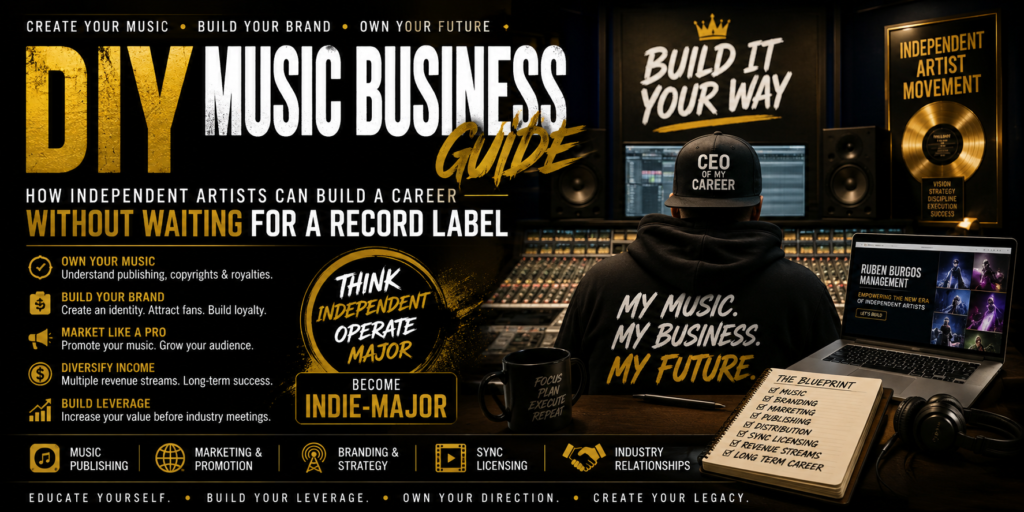
The music industry has changed. Independent artists no longer have to spend their entire careers waiting for a record-label executive to discover them, approve their music, finance their project, or give them permission to build an audience. Technology has placed recording, distribution, marketing, publishing administration, direct-to-fan communication, content creation, analytics, merchandise, and global promotion within reach of independent musicians.
But access does not automatically create success.
The difference between simply uploading music and building a music business comes down to infrastructure, knowledge, consistency, ownership, strategy, and execution. Independent artists must begin thinking beyond the next song. Your music is the creative product, but your career is the business surrounding that product.
At Ruben Burgos Management, we call this mentality Indie-Major: maintain the entrepreneurial advantages of independence while developing the organization, presentation, discipline, marketing strategy, and business infrastructure expected from a serious music company.
You don’t have to wait to become valuable to the industry. You can start building that value yourself.
Stop Waiting to Be Discovered
One of the most damaging ideas an emerging artist can adopt is believing that a record deal is the starting line.
It isn’t.
Before approaching labels, publishers, managers, booking agents, investors, or other industry professionals, ask yourself: What have I already built?
Do you have professionally released music? Do you understand who owns your masters and compositions? Are your songwriter and producer splits documented? Do you have a recognizable artist brand? Are listeners consistently engaging with your music? Do you collect fan contact information? Do you understand where your strongest audiences are located? Can you demonstrate ticket, merchandise, or music-related sales? Do you have professional photographs, biographies, videos, artwork, and an electronic press kit?
These assets create leverage.
The stronger your independent operation becomes, the less your career depends upon somebody simply believing your potential. Instead, you can begin showing evidence of that potential.
Treat Your Music Like Intellectual Property
Every serious DIY music career should begin with understanding the assets being created.
A song can involve two fundamental copyrights: the musical composition and the sound recording. These are different assets and can have different owners.
If you wrote a song with other writers, establish the ownership percentages. If a producer created the beat, understand the agreement governing the production. Keep records of collaborators, credits, ownership, agreements, and relevant metadata.
Artists should also educate themselves about performing-rights organizations, mechanical royalties, neighboring rights where applicable, publishing administration, master royalties, digital distribution, and other potential sources of music income.
You don’t need to become an entertainment attorney to be an artist, but you should understand enough about your business to recognize when professional legal, accounting, publishing, or management assistance is necessary.
Never assume that uploading a song automatically means every possible royalty will magically find you.
Create the music. Document the music. Protect the music. Understand the business surrounding the music.
Build Your Own Music Infrastructure
Think of your career as a company.
Your infrastructure should gradually include a professional artist identity, dedicated email address, official website, distribution system, organized music catalog, electronic press kit, professional photos, artwork, videos, social platforms, analytics, fan database, bookkeeping system, contracts and agreements, marketing calendar, content library, and organized cloud storage.
Your website is particularly important because social platforms are rented territory. Algorithms change. Accounts can lose reach. Platforms can rise and fall.
Your website can become the central destination connecting your music, biography, videos, merchandise, press coverage, tour information, booking contacts, mailing list, and other important assets.
The objective is simple: make it easy to understand who you are, what you represent, and how someone can do business with you.
Build a Brand, Not Just a Collection of Songs
Great music matters, but today’s artist operates in an attention economy.
People need a reason to remember you.
Your brand includes your artist name, imagery, artwork, fashion, colors, photography, personality, messaging, story, content style, audience experience, and what people emotionally associate with you.
Ask yourself three questions:
Who am I? Who is my music for? Why should people remember me?
Don’t manufacture a personality simply because you think it will become popular. The strongest brands usually amplify something authentic about the artist.
Consistency creates recognition. Recognition can eventually create trust. Trust can turn casual listeners into committed supporters.
Stop Marketing to Everybody
One million random impressions can be less valuable than a smaller audience of people who genuinely care about your music.
Learn your target audience.
Study your streaming analytics, social engagement, video performance, website traffic, mailing-list growth, geographic data, merchandise customers, and live-show attendance.
Which songs generate the strongest response? Where do your listeners live? Which content keeps people’s attention? Which posts generate profile visits? Which cities deserve additional promotion? What type of listener repeatedly returns?
Marketing becomes stronger when it stops being based entirely on assumptions.
Data should inform creativity—not replace it.
Build a Release Campaign
Uploading a song is distribution. It isn’t automatically marketing.
Every important release should have a campaign surrounding it.
Before release day, prepare artwork, promotional photographs, video assets, short-form clips, storytelling content, press materials, an updated EPK, website information, email announcements, relevant pitches, and a schedule for communicating with your audience.
Release day should be the beginning of another marketing phase—not the funeral of the campaign.
Continue promoting the song afterward through live performances, alternate content, behind-the-scenes footage, lyric explanations, interviews, collaborations, visualizers, acoustic versions where appropriate, audience reactions, creator outreach, and other legitimate opportunities.
A great record that nobody knows exists has a discovery problem.
Own Your Audience
Followers matter, but direct relationships matter more.
Whenever appropriate, encourage supporters to join an email list, visit your website, purchase merchandise, attend performances, or otherwise become part of an artist-controlled community.
Why?
Because you shouldn’t have to start from zero every time you release something.
Imagine having thousands of genuine supporters you can communicate with directly whenever you announce a song, album, tour, merchandise collection, event, or special project.
That is infrastructure.
Create Multiple Revenue Streams
A sustainable music career should not depend exclusively on streaming.
Depending on the artist, rights, agreements, market, and career stage, potential revenue can include recorded music, publishing royalties, live performances, merchandise, direct-to-fan products, brand partnerships, licensing, synchronization opportunities, production, songwriting, features, fan experiences, content, and other creative services.
Not every revenue stream is appropriate for every musician.
The objective isn’t to chase everything simultaneously. The objective is to understand the possibilities and strategically develop the opportunities that fit your career.
For example, an artist interested in synchronization should think beyond simply having good songs. Music supervisors and licensing professionals may need accurate metadata, clear ownership information, instrumental versions, clean versions, stems, alternate mixes, and the ability to clear rights efficiently.
Professional preparation creates opportunity.
Build a Team Before You Build an Entourage
As your operation grows, you may need professionals around you.
There is an enormous difference between having people around and having a team.
A developing artist’s professional network may eventually involve an entertainment attorney, manager, accountant, business manager, booking professional, publicist, marketing strategist, producer, engineer, photographer, videographer, graphic designer, web developer, or other specialists.
You don’t necessarily need everyone immediately.
Build according to your needs and resources.
Most importantly, understand what each person is supposed to accomplish. Relationships should have defined responsibilities, expectations, communication, and—where appropriate—written agreements.
A successful artist doesn’t need the largest team.
They need the right team.
Develop Leverage Before Approaching Labels
A label meeting should not be viewed as an opportunity to beg someone to make you successful.
Ideally, it should become a business conversation about how two parties might create greater value together.
Your leverage could come from exceptional music, audience growth, ticket sales, streaming activity, cultural influence, social engagement, press attention, merchandise demand, valuable intellectual property, industry relationships, or an unusually strong brand.
Different companies prioritize different factors, and there is no universal number that guarantees a deal.
The principle, however, remains powerful:
Build something worth discussing before entering the discussion.
When you finally sit across from an executive, know your story. Know your numbers. Know your audience. Know your catalog. Know your objectives.
Most importantly, know what you want from the relationship.
Money? Marketing? Distribution? International expansion? Radio strategy? Creative resources? Partnerships? Touring support?
If you don’t know what you’re looking for, it becomes much harder to evaluate what you’re being offered.
Learn the Art of the Label Meeting
Professional communication is an underrated music-business skill.
Don’t enter the room pretending to know everything. Don’t inflate numbers. Don’t spend the entire meeting telling executives how legendary you’re going to become.
Demonstrate preparation.
Explain who you are, what makes your music distinctive, who your audience is, what you’ve accomplished, what you’re building, and where you believe the right strategic partner could accelerate the operation.
Then listen.
Ask intelligent questions.
If contractual terms are presented, don’t allow excitement to replace judgment. Major business decisions deserve careful evaluation and, when appropriate, independent professional legal and financial advice.
Getting offered a deal and getting offered the right deal are not the same accomplishment.
Think Independent. Operate Major.
Being independent shouldn’t mean being disorganized.
You can be independent and still maintain professional accounting. Independent and still have world-class branding. Independent and still execute sophisticated campaigns. Independent and still understand contracts. Independent and still build international audiences.
That is the foundation of the Indie-Major mentality.
Don’t imitate the size of a major company.
Learn from its systems.
Study how professional organizations coordinate releases, branding, public relations, marketing, distribution, publishing, analytics, licensing, partnerships, and long-term catalog development. Then build the appropriate version around your own resources.
Start small. Build correctly. Scale intelligently.
Become Valuable Before Asking for Validation
The DIY revolution isn’t about rejecting record labels.
It’s about eliminating the belief that you must remain powerless until one arrives.
The right label, distributor, publisher, manager, investor, or strategic partner can potentially accelerate an artist’s career. But partnership becomes a different conversation when you’ve already established ownership, infrastructure, audience, professionalism, revenue, and momentum.
Don’t spend your career standing outside the industry’s door asking someone to let you inside.
Build something powerful enough that the industry has a reason to knock on yours.
Your first responsibility is your craft. Your second is understanding the business surrounding it.
Write better songs. Make better records. Study your audience. Protect your rights. Build your brand. Develop your infrastructure. Learn marketing. Create revenue. Maintain accurate records. Build genuine relationships. Measure results. Improve your weaknesses.
Then repeat.
That is how an independent artist begins becoming an independent business.
And that is where Indie-Major begins.
Written by Ruben Burgos Management | RubenBurgos.com
The DIY Music Business Educational Series was created to empower independent and emerging artists with practical knowledge about music publishing, marketing, promotion, branding, syndication, sync licensing, artist development, label preparation, and music-business strategy. Our mission is to help today’s independent artist think bigger, operate smarter, protect their creativity, and develop the infrastructure necessary to take their craft to the next level.
Don’t wait for the music business to teach you the business. Educate yourself. Build your leverage. Own your direction. Think independent. Operate major. Become Indie-Major.