

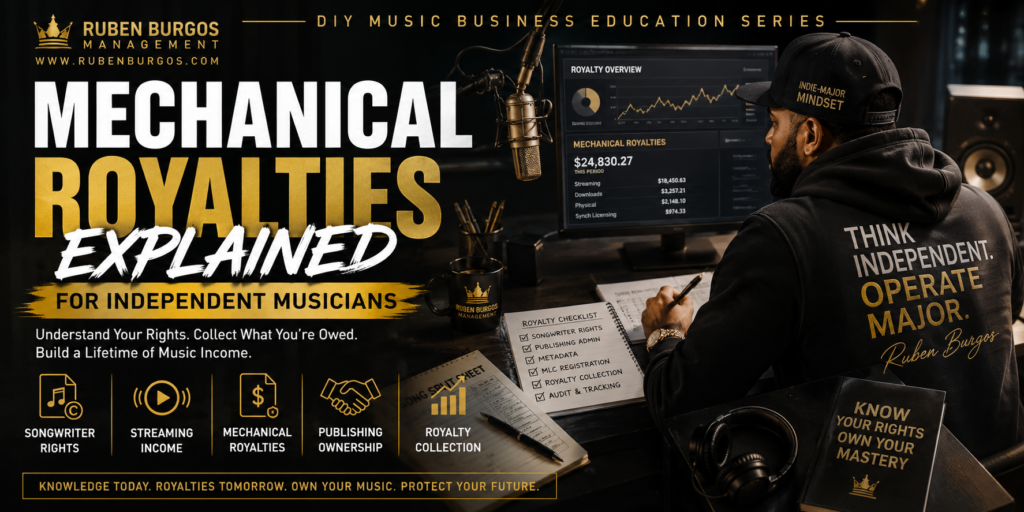
How Songwriters Can Understand Streaming Income, Protect Their Rights, and Build a Stronger Royalty Collection Strategy
For independent musicians, releasing a song is only one part of the music business. The other part is understanding where the money generated by that song can go and how eligible royalties may reach the people who own the underlying rights. One of the most misunderstood areas of music publishing is the mechanical royalty.
An independent artist can write, record, distribute, and promote great music and still have gaps in royalty collection if the business side of the composition isn’t properly organized. Streams may be growing. Fans may be listening. Content may be circulating. Yet the songwriter can still be asking an important question: Am I collecting everything I’m entitled to collect?
Mechanical royalties are part of that conversation.
This Ruben Burgos Management DIY guide explains mechanical royalties, how they differ from other music income, how interactive streaming can generate mechanical royalties for compositions, why songwriter and publishing rights matter, and why independent musicians should build their royalty infrastructure as seriously as they build their music.
What Are Mechanical Royalties?
A mechanical royalty is generally associated with the reproduction and distribution of a musical composition.
Think about a song as having different layers of intellectual property. There is the composition—the melody, lyrics, and underlying song—and there is the sound recording, commonly called the master.
Those are not the same copyright.
If you write a song and then record yourself performing that song, you may have interests in both the composition and the master. Different uses of the music can therefore generate different types of income.
Mechanical royalties concern the composition side.
Historically, the term developed around physical reproductions of music. When songs were manufactured and distributed on formats such as records, tapes, and CDs, the reproduction of the composition could trigger mechanical royalty obligations.
The digital music economy expanded the concept.
Downloads and certain types of digital streaming can involve mechanical rights as well. That means a songwriter needs to understand that a stream isn’t necessarily associated with only one bucket of money.
Streaming Changed the Mechanical Royalty Conversation
Streaming has made royalty accounting more complicated for many independent musicians.
When a listener plays music through an interactive, on-demand streaming service, multiple rights can be implicated. On the composition side, this can include both performance rights and mechanical rights.
That distinction matters.
An artist may register with a performing rights organization and assume that every publishing-related royalty is therefore handled. But performance royalties and mechanical royalties are different categories, and the organizations and systems involved in collecting them can differ.
For an independent songwriter, the lesson is simple:
Never assume one registration automatically covers every possible royalty source.
Learn what each organization does, which rights it administers, what territory it covers, and whether additional registrations or publishing-administration arrangements are appropriate for your situation.
Your Master and Your Composition Are Different Assets
Every serious independent musician should understand the distinction between the sound recording and the musical composition.
Imagine you write a song called Never Stop Hustling.
The lyrics and melody make up the composition.
You enter a studio, perform the song, and create a finished recording. That particular recording is the master.
Now imagine another artist legally records a cover of your song. Their recording would be a different master, but the underlying composition would still involve the song you wrote.
This is why music ownership can become complicated—and why accurate documentation is so important.
An independent artist should know who wrote the song, who owns the master, who controls the publishing interests, whether there are co-writers, whether a producer received songwriting ownership, and what agreements govern those relationships.
Your career becomes much easier to administer when those questions are answered before the money arrives.
Songwriter Rights Matter
If you participate in writing a song, your songwriting contribution may carry valuable rights.
But simply knowing that you helped write something isn’t enough for a professional operation. Ownership should be documented.
Suppose four people create a record during a studio session. One writes the hook, another contributes verses, another develops melodic elements, and a producer contributes material everyone agrees qualifies for songwriting ownership.
What percentage belongs to each contributor?
That conversation can become uncomfortable after a song succeeds.
Handle it early.
This is why split sheets and written agreements can be so important. A split sheet can document who contributed to a composition and the percentages the participants agreed upon.
The larger principle is even more important:
Treat songwriting like an asset from the moment it is created.
Memories fade. Relationships change. Careers grow. Money can transform friendly misunderstandings into expensive disputes.
Documentation protects relationships as much as it protects business.
Where Do Mechanical Royalties Come From?
Depending on the use, territory, applicable law, agreements, and collection structure, mechanical royalties can arise from activities such as physical reproduction, permanent digital downloads, and qualifying interactive streams.
The exact royalty process can vary significantly between markets and services.
For U.S. interactive streaming, the system has evolved substantially, including through the Music Modernization Act and the creation of the Mechanical Licensing Collective for certain blanket digital mechanical licensing and administration.
Independent musicians should understand the system without assuming that every stream has a simple fixed mechanical value.
Streaming royalties can involve formulas, statutory frameworks, service revenue, subscriber models, usage, rights ownership, and other factors.
So be careful when someone tells you:
“One stream always equals exactly this much money.”
Music royalties generally aren’t that simple.
What Is The Mechanical Licensing Collective?
For independent songwriters operating in the United States, The Mechanical Licensing Collective (The MLC) is an important organization to understand.
The MLC administers the blanket mechanical license for eligible digital audio uses by digital music providers in the United States and works to identify musical works, match usage data, and distribute eligible mechanical royalties to rightsholders.
But musicians should still educate themselves about eligibility, registration, data accuracy, and whether they are already represented by a publisher or publishing administrator.
The objective isn’t to register everywhere blindly.
The objective is to know who is responsible for collecting what on your behalf.
If you have a publishing administrator, publisher, attorney, manager, or other professional assisting with your catalog, understand their responsibilities and avoid creating conflicting registrations.
A PRO Is Not the Same Thing as Mechanical Collection
This distinction deserves special attention.
Performing rights organizations—commonly called PROs—focus on public-performance rights for compositions within their respective systems and territories.
Mechanical royalties concern a different right.
This means joining a PRO can be important for a songwriter, but musicians shouldn’t automatically interpret PRO membership as proof that their entire publishing operation is covered.
Think of your royalty system as multiple pipelines.
One pipeline might concern your master-recording revenue.
Another might concern composition performance royalties.
Another can involve mechanical royalties.
Additional income can potentially arise from synchronization licensing, neighboring rights, physical products, direct licenses, and other uses.
The professional artist learns where every pipeline begins and where the money is supposed to end.
Why Metadata Can Affect Your Money
One of the least glamorous aspects of music is also one of the most important:
data.
Your music needs accurate information attached to it.
Song title, songwriter names, ownership percentages, publisher information, recording information, identifiers, and other metadata can play important roles in identifying works and matching usage with the correct rightsholders.
Imagine having thousands or millions of streams but inconsistent information across music-industry databases.
That creates potential problems.
Independent artists often spend enormous amounts of energy perfecting cover artwork, social-media campaigns, videos, and release parties while treating metadata as an afterthought.
Reverse that mentality.
Your creative presentation gets attention.
Your business information helps make the music administrable.
Both matter.
The Independent Artist’s Royalty Audit
Every developing artist should periodically conduct a royalty audit of their catalog.
Start with your songs.
Identify every composition you have written or co-written. Determine who the co-writers are and confirm the agreed ownership splits. Review whether your works are properly represented within the relevant systems you rely on.
Then examine your recordings.
Who owns each master? Which distributor handles it? Are the recording credits accurate? Do the titles and contributor information match across your documentation?
Next, map your collection infrastructure.
Know which organizations, publishers, administrators, distributors, or other partners are responsible for different revenue categories.
Finally, keep records.
Save agreements, registrations, statements, identifiers, split sheets, licenses, contracts, and important correspondence in an organized system.
Your catalog should be treated like a business portfolio.
Don’t Wait Until the Song Goes Viral
The worst time to begin figuring out ownership is after a record explodes.
Imagine a song suddenly generating massive attention. Streams increase. Creators begin using it. Media opportunities arrive. A television producer wants to license it. A label starts calling.
Now everyone is asking:
Who owns the master?
Who wrote the song?
Who controls the publishing?
Can it be cleared?
Are there samples?
What are the splits?
Who has authority to approve a license?
If nobody knows the answers, opportunity can turn into confusion.
Independent does not have to mean unorganized.
Being independent should mean being empowered enough to understand your own business.
Mechanical Royalties Are Part of a Bigger Publishing Strategy
Mechanical royalties shouldn’t be viewed in isolation.
A serious publishing strategy means understanding how compositions can generate different forms of income and how ownership creates long-term value.
Your song isn’t valuable only on release day.
A composition can potentially continue producing economic opportunities for years through streaming, performances, recordings, licensing, and other authorized uses.
That’s why successful independent artists need to think beyond:
“How many streams did I get?”
Start asking:
What rights do I own?
Who administers those rights?
Where are those rights registered?
Which revenue categories apply to my music?
Who is responsible for collecting each category?
Are my records and metadata accurate?
Those are business-owner questions.
Think Independent. Operate Major.
The modern independent artist has unprecedented access to recording technology, digital distribution, social media, marketing platforms, analytics, direct-to-fan communication, and global audiences.
But access without education can still leave money and opportunity on the table.
Being Indie-Major means adopting the freedom and ownership mentality of independence while developing the organization, infrastructure, strategy, presentation, and discipline expected from a professional music enterprise.
Don’t only record like a professional.
Document like one.
Register like one.
Market like one.
Negotiate like one.
Track your business like one.
And when you don’t understand something involving your rights or contracts, seek qualified professional guidance rather than signing first and asking questions later.
Your songs are creative expressions, but they can also become intellectual-property assets.
Treat them accordingly.
The Ruben Burgos Management Bottom Line
Mechanical royalties may sound technical, but the fundamental lesson is straightforward:
Know your music. Know your ownership. Know your rights. Know your collection infrastructure.
Every independent musician should understand the difference between a composition and a master recording. Songwriters should understand their agreed ownership percentages. Collaborators should document splits. Artists should maintain accurate metadata and understand which organizations or partners handle the various parts of their royalty collection.
Don’t become obsessed with appearing successful while neglecting the infrastructure capable of supporting actual success.
The artist who understands the business behind the music enters negotiations differently.
The artist who understands ownership thinks differently.
And the artist who knows where the money flows can make better decisions about the future of their catalog.
Education creates leverage.
Ownership creates possibilities.
Organization protects opportunity.
And knowledge gives independent artists something they should never willingly surrender:
control over the direction of their careers.
Written by Ruben Burgos Management | RubenBurgos.com
The DIY Music Business Educational Series was created to empower independent and emerging artists with practical knowledge about music publishing, marketing, promotion, branding, syndication, sync licensing, artist development, label preparation, and music-business strategy. Our mission is to help today’s independent artist think bigger, operate smarter, protect their creativity, and develop the infrastructure necessary to take their craft to the next level.
Don’t wait for the music business to teach you the business. Educate yourself. Build your leverage. Own your direction. Think independent. Operate major. Become Indie-Major.
Educational information only. Royalty, copyright, licensing, contractual, tax, and collection circumstances can vary by territory and individual situation. Artists should consult appropriate music-business, legal, accounting, or publishing professionals when advice specific to their rights or agreements is required.