

For an independent artist, creating a great song is only part of the music business. Understanding who owns that song, who controls the rights, how those rights generate income, and how the money is collected can be just as important as recording and promoting the music.
Too many emerging artists concentrate exclusively on streams, followers, videos, performances, and getting discovered while overlooking the business infrastructure underneath their music. A song can potentially generate income through multiple uses and territories for years. If the artist doesn’t understand publishing, ownership, registrations, and royalty collection, some of that value can become difficult to track or collect.
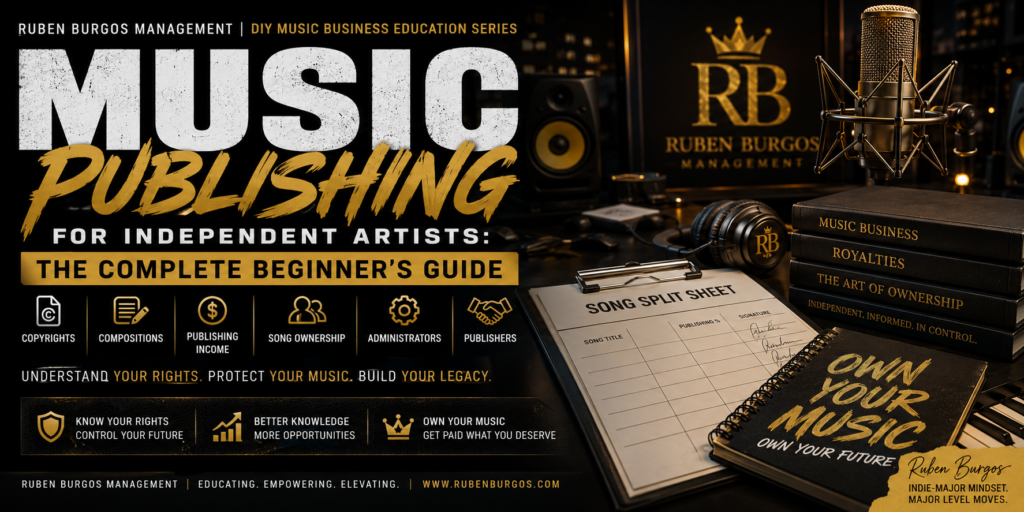
This Ruben Burgos Management DIY guide provides a beginner-friendly introduction to music publishing so independent artists can approach their careers with greater knowledge.
Create like an artist. Protect yourself like an owner. Operate like a business.
What Is Music Publishing?
Music publishing revolves around the rights and commercial exploitation associated with the musical composition—the underlying song, including elements such as lyrics and melody.
One of the first concepts every independent artist should understand is that a commercially released song can involve separate copyrights.
Think about it this way:
The composition is the song.
The master is a particular recording of that song.
If you write a song called Independent Dreams, you have created a composition. When you enter a studio and record a particular version of Independent Dreams, that recording can have its own separate copyright.
This distinction matters because different rights can generate different forms of income.
Copyright Begins With Creation—but Documentation Matters
In the United States, copyright protection generally exists once an original work is created and fixed in a tangible medium. For a songwriter, that could mean recording the song or writing it down.
However, artists should not confuse copyright existing with having every possible enforcement benefit or business record in place. Formal registration with the U.S. Copyright Office can provide important legal benefits. Independent artists should therefore learn about registration rather than assuming uploading a song to a streaming service is all the protection they need.
Songwriters should also maintain accurate records of who contributed to each composition.
Who wrote the lyrics?
Who wrote the melody?
Were there co-writers?
Were samples or interpolations involved?
What percentages did everyone agree to?
Those questions are much easier to resolve before money and success enter the conversation.
Understanding Song Ownership
Imagine two writers create a song together.
Before releasing it, they should discuss and document their respective ownership interests. This is where a split sheet can become valuable.
A split sheet typically records information such as the song title, writers, ownership percentages, contact information and other relevant identifying information.
The purpose is simple: create clarity.
One of the worst business strategies is:
“We’ll figure it out if the song becomes successful.”
Success can magnify disagreements.
Have the conversation early.
If three people contributed to a composition, don’t simply assume everyone remembers the arrangement identically six months later. Document the agreement and keep your records organized.
When significant money, contractual rights, samples, work-for-hire questions, or complicated collaborations are involved, obtain advice from a qualified music attorney.
Publishing Income: How Can a Composition Generate Money?
A composition may generate publishing-related income through different uses.
Depending on the circumstances, territory, agreements, and exploitation, income can potentially arise from areas including:
Performance royalties — generated by qualifying public performances or transmissions of compositions.
Mechanical royalties — associated with certain reproductions and distributions of musical compositions, including applicable digital uses.
Synchronization licensing — when a composition is licensed for synchronization with visual media such as television, films, advertisements, games, or online productions.
Print and other licensing — depending on the composition and how it is commercially exploited.
The important lesson isn’t to memorize every royalty category overnight.
The lesson is to recognize that a stream isn’t necessarily one simple payment traveling through one pipeline.
Different rights can involve different organizations and collection systems.
What Are Performing Rights Organizations?
Performing rights organizations—commonly called PROs—play an important role in the publishing ecosystem.
In the United States, organizations include ASCAP, BMI, SESAC and GMR. Their structures and eligibility requirements differ, so artists should research which organization fits their circumstances.
PROs generally license certain public performances of compositions and distribute applicable royalties to songwriters and publishers according to their systems.
This leads to another important lesson:
Registering with a distributor and registering your publishing interests are not the same thing.
A digital distributor primarily helps deliver recordings to digital services. That does not automatically mean every possible publishing royalty associated with your compositions is being administered and collected for you.
Independent artists need to understand each part of their infrastructure.
What Is a Music Publisher?
Traditionally, music publishers work with songwriters and compositions to help administer and commercially exploit publishing rights.
Depending on the agreement, a publisher may assist with areas such as administration, royalty collection, registrations, licensing, creative opportunities, song pitching, synchronization opportunities and catalog management.
But publishing deals vary enormously.
Never assume that because one songwriter signed a particular type of publishing agreement, yours will operate the same way.
Before signing, understand questions including:
- What rights are you granting?
- How long does the agreement last?
- Which territories are covered?
- What income is shared?
- What services is the publisher obligated to provide?
- What happens to your rights when the agreement ends?
- Are there advances, and if so, how are they recouped?
- Is the agreement exclusive?
A contract should be understood before it is signed—not after a disagreement develops.
What Is Publishing Administration?
A publishing administrator is different from simply saying, “Someone owns my publishing.”
Under many administration arrangements, the songwriter or publisher retains ownership while granting an administrator specified rights to administer compositions, register works, issue or process certain licenses, and collect applicable publishing income in exchange for agreed fees or commissions.
The exact arrangement depends on the contract.
For independent artists who want to retain ownership while obtaining help with the administrative workload, publishing administration can be worth researching.
But again:
Read the agreement.
“Administration” does not mean every contract has identical terms.
What About Mechanical Royalties?
Mechanical royalties are another area independent musicians frequently overlook.
In the United States, The Mechanical Licensing Collective (The MLC) administers blanket mechanical licensing and distributes eligible mechanical royalties for certain uses by qualifying digital music providers under the Music Modernization Act framework.
That does not mean every artist should blindly register everywhere without understanding their situation.
Instead, independent songwriters should investigate how their compositions are registered, whether another publisher or administrator is already collecting on their behalf, and which organizations apply to their rights and catalog.
The goal is to build a system—not create duplicate or conflicting registrations.
Sync Licensing: Publishing Meets Visual Media
Imagine your song appears during an important scene in a television show.
That use can involve synchronization rights in the composition and, when the existing recording is used, rights in the master recording as well.
This is why owning or controlling both sides can sometimes make an independent artist attractive for certain sync opportunities: if the necessary rights are straightforward to clear, licensing may be more efficient.
Artists interested in sync should maintain organized information including:
Songwriter information
Publishing information
Master ownership
Split percentages
PRO affiliations
Contact information
Metadata
Instrumental versions
Clean versions
Stems when appropriate
Professional organization matters.
A music supervisor shouldn’t have to conduct an investigation to discover who controls your song.
Don’t Give Away Rights You Don’t Understand
Artists are frequently excited when someone offers them an opportunity.
Excitement shouldn’t replace due diligence.
If someone asks for publishing rights, master rights, administration rights, exclusivity, licensing authority, or a percentage of future income, understand exactly what is being requested and what you’re receiving in exchange.
A contract that seems harmless today can become extremely important if the song becomes valuable tomorrow.
Never be embarrassed to say:
“I need my attorney to review this.”
That isn’t being difficult.
That’s business.
Build a Pre-Release Publishing Checklist
Before releasing an important record, an independent artist should know the answers to several basic questions:
Who wrote the composition?
Are the songwriter splits agreed upon and documented?
Who owns or controls the publishing interests?
Who owns the master recording?
Are samples and interpolations properly cleared when required?
Is the song’s metadata accurate?
Have applicable registrations been handled?
Who is responsible for publishing administration and royalty collection?
Do all collaborators understand the agreement?
If you cannot answer these questions, consider addressing them before launching a major marketing campaign.
Why Publishing Knowledge Creates Leverage
Knowledge changes negotiations.
An artist who understands masters, compositions, publishing, royalties, licensing, metadata, and contracts enters business conversations differently from an artist who only knows how many streams they have.
You don’t need to become an entertainment attorney.
You do need to understand enough about your business to recognize when you need one.
Independent doesn’t mean doing absolutely everything alone.
It means developing enough knowledge to make informed decisions about who you hire, what you delegate, what you sign, and what you retain.
That is part of the Indie-Major mentality.
Build independently while establishing professional infrastructure capable of operating at a higher level.
Treat Your Catalog Like Intellectual Property
Your catalog isn’t simply a folder containing songs.
It can become a portfolio of intellectual property.
Today’s record might be tomorrow’s sync opportunity. A composition written years ago might find a new audience. A song that initially receives modest attention could later become valuable through another artist’s recording, a placement, a viral resurgence, or a new licensing opportunity.
That is why ownership records matter.
That is why metadata matters.
That is why agreements matter.
And that is why publishing education matters.
Final Word: Know What You Own
Independent artists spend enormous amounts of time trying to become visible.
But visibility without infrastructure can create problems.
Before chasing the label meeting, playlist, viral video, influencer campaign, major collaboration, or sync placement, understand the foundation underneath your music.
Know what you created.
Know what you own.
Know what you’ve agreed to share.
Know who administers your rights.
Know how your income is supposed to reach you.
And when you don’t know—ask qualified professionals before making irreversible decisions.
Your creativity creates the music. Your knowledge helps protect the business surrounding it.
Written by Ruben Burgos Management | RubenBurgos.com
The DIY Music Business Educational Series was created to empower independent and emerging artists with practical knowledge about music publishing, marketing, promotion, branding, syndication, sync licensing, artist development, label preparation, and music-business strategy. Our mission is to help today’s independent artist think bigger, operate smarter, protect their creativity, and develop the infrastructure necessary to take their craft to the next level.
Don’t wait for the music business to teach you the business. Educate yourself. Build your leverage. Own your direction. Think independent. Operate major. Become Indie-Major.
Educational disclaimer: This article provides general music-business education and is not legal, tax, accounting, or financial advice. Copyright, royalty, publishing, and contractual situations vary. Artists should consult qualified professionals regarding their individual circumstances.