

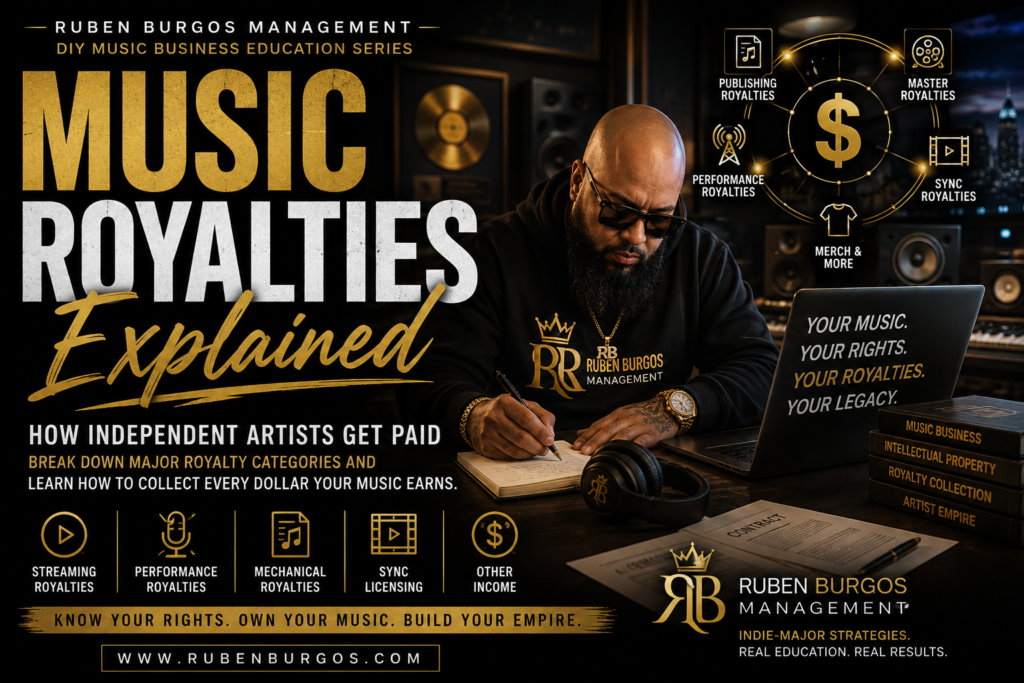
A DIY Music Business Guide for Independent & Indie-Major Artists
For an independent artist, releasing a song is exciting—but uploading your music to streaming platforms is only the beginning of the financial journey. One recording can potentially create several different types of revenue, and those payments may travel through different companies, organizations, distributors, publishers, administrators, and collection systems before reaching the people entitled to receive them.
This is where many talented musicians lose sight of the business behind their music.
You can have thousands—or eventually millions—of streams and still fail to capture every revenue opportunity associated with your work if your rights, registrations, metadata, agreements, and collection systems aren’t properly organized.
At Ruben Burgos Management, we believe the independent artist of today should understand both sides of the equation: the music and the business.
If you want to operate like an Indie-Major, you need to understand what you own, what generates money, who collects that money, and what steps you need to take to position yourself to receive it.
Let’s break it down.
One Song Can Contain Two Major Copyrights
Before understanding royalties, understand this fundamental distinction.
A commercially released song generally involves two separate copyrighted works:
1. The musical composition — the underlying music and lyrics created by songwriters and composers.
2. The sound recording, or master — the particular recorded performance of that composition.
Imagine you write a song called My Dream. The lyrics and melody represent the composition.
You then enter a studio and record My Dream. That finished recording represents the master recording.
These rights can have different owners.
An independent artist might own both. In other situations, songwriters, publishers, producers, labels, investors, or other parties may have contractual interests in one or both.
That distinction matters because different uses of music can generate different royalties for the composition and master.
Understanding ownership should therefore begin before the release date, not after the song starts gaining attention.
1. Streaming Revenue From the Master Recording
When your recording is streamed through digital music services, revenue attributable to the sound recording can flow through the distribution and rights structure associated with that recording.
Independent musicians commonly use digital distributors to deliver recordings to streaming platforms.
Depending on the distributor and agreement, the distributor may receive revenue associated with the master and then account to the artist or appropriate rights holder after applicable fees, commissions, or other contractual deductions.
An important misconception needs to be addressed here:
There is no universal fixed “per-stream rate.”
What a stream ultimately generates can vary according to the service, country, subscription type, revenue model, contractual arrangements, and other factors.
Therefore, don’t build your entire career around statements such as, “One million streams automatically equals X dollars.”
Music economics are more complicated.
Instead, understand the chain:
Recording → Distributor/rights arrangement → Digital service → Revenue/accounting → Master rights holder
And remember: receiving master-related streaming revenue doesn’t necessarily mean you’ve collected every other royalty associated with the same song.
2. Performance Royalties
Songwriters and publishers can potentially earn performance royalties when compositions are publicly performed in qualifying contexts.
These uses can include certain:
- Radio broadcasts
- Television broadcasts
- Live performances
- Digital music uses
- Public performances
- Other licensed uses
Performing Rights Organizations, commonly called PROs, play an important role in licensing certain public performances and distributing eligible royalties according to their systems and data.
In the United States, organizations operating in this area include ASCAP, BMI, SESAC and GMR, although their structures and eligibility requirements differ.
If you wrote your music, understanding how your compositions are represented for performance-rights purposes should be part of your business infrastructure.
Simply putting your song online doesn’t automatically mean every organization that could potentially account for a use has all the information necessary to connect that use with you.
Registration and accurate data matter.
3. Mechanical Royalties
Mechanical royalties are another major publishing-side category.
Generally speaking, mechanical royalties arise from certain reproductions and distributions of musical compositions, including eligible digital uses.
Streaming has made this category particularly important—and confusing—for independent songwriters.
An artist may see money arriving from a distributor for recordings and mistakenly assume:
“That’s all my streaming money.”
Not necessarily.
The master and composition are separate rights.
In the United States, The Mechanical Licensing Collective (The MLC) administers certain blanket mechanical licensing and royalty processes for eligible digital audio uses under U.S. law.
Independent songwriters should educate themselves about how their publishing rights are administered and whether the appropriate organizations have accurate information about their works.
Money can’t efficiently find you when the business information attached to your music can’t identify you.
4. Publishing Income
Music publishing isn’t simply another word for streaming revenue.
Publishing concerns the underlying song.
If you write your own material, you aren’t only the performing artist—you may also have rights as a songwriter.
Publishing revenue can involve multiple categories depending on how compositions are exploited.
This can include performance and mechanical income as well as negotiated licensing income.
Some independent songwriters self-administer aspects of their publishing. Others work with publishing administrators or publishers.
The correct arrangement depends on the artist’s catalog, territories, goals, contracts, and business situation.
But the central lesson remains:
Don’t become so focused on being the artist that you forget you may also be a songwriter and rights owner.
Your intellectual property is part of your business.
5. Sound Recording Digital Performance Royalties
There is another revenue category independent artists should understand, particularly in the United States.
Certain non-interactive digital performances of sound recordings—such as qualifying digital radio services—can generate sound-recording performance royalties.
In the United States, SoundExchange collects and distributes certain statutory digital performance royalties to eligible featured artists and sound-recording copyright owners, with statutory allocations also involving non-featured performers through designated organizations.
This isn’t identical to the songwriting performance royalties handled by PROs.
Again, this demonstrates why “royalties” should never be treated as one single bucket.
Different rights.
Different uses.
Different collection systems.
6. Sync Licensing Revenue
What happens when somebody wants to use your song in a movie, television program, advertisement, trailer, video game, or other audiovisual production?
Welcome to sync licensing.
A synchronization license concerns pairing a musical composition with visual media. When an existing master recording is also being used, rights to that recording generally need to be cleared separately.
If you control both the composition and master, you may be able to offer potential licensees a simpler clearance path—subject, of course, to any collaborators, samples, agreements, or other interests attached to the music.
Sync opportunities can involve negotiated fees rather than a universal royalty rate.
Depending on the use, additional performance income may also arise later in qualifying contexts.
For independent musicians interested in sync, organization is essential.
Know:
Who owns the master?
Who wrote the composition?
What are everyone’s percentages?
Are there samples?
Can the music be cleared quickly?
Do you have instrumental and clean versions?
Is your metadata accurate?
A music supervisor may love a record, but complicated or uncertain ownership can make licensing harder.
7. Producer Royalties and Contractual Participation
Producers are another important part of the royalty conversation.
A producer’s compensation can potentially include upfront fees, royalties, ownership interests, or other negotiated participation depending on the agreement.
There isn’t one universal producer deal.
Independent artists should stop relying exclusively on verbal assumptions.
If you work with producers, establish in writing what was agreed upon.
Who owns the beat?
Is the instrumental licensed or sold?
Are there restrictions?
Does the producer have songwriting ownership?
Is there master participation?
Are there royalties?
What credits are required?
Handling these questions before a successful release is usually much easier than arguing about them after money arrives.
8. YouTube and User-Generated Content
Music can also generate value when it appears in videos and user-generated content.
Rights-management systems may identify eligible copyrighted recordings or compositions used within online content and monetize, track, or otherwise manage those uses depending on the platform, territory, rights, and applicable agreements.
But artists need to understand exactly what rights they are authorizing someone to administer.
Before signing up for any rights-management or monetization service, understand:
- Which rights you’re granting
- Whether the arrangement is exclusive
- Which territories are covered
- What commission is charged
- How disputes are handled
- How long the agreement lasts
- How termination works
Never hand over rights simply because somebody promises to “collect everything.”
Read the agreement.
9. International Royalties
Music doesn’t stop at the American border.
An independent artist can build listeners in London, Toronto, Paris, Lagos, Tokyo, Berlin, Sydney, Johannesburg, São Paulo, or virtually anywhere music services operate.
That creates another important question:
Is your royalty infrastructure prepared for international activity?
Collection systems vary by territory and type of right. Publishers, administrators, collection societies, distributors, and other rights-management partners can play different roles in international royalty collection.
As your catalog and audience grow, international administration can become increasingly important.
Think globally from the beginning.
Metadata: The Information Behind Your Money
One of the least glamorous parts of the music business may also be one of the most important:
metadata.
Metadata identifies your music and the people connected to it.
Depending on context, important information can include:
- Artist name
- Song title
- Songwriters
- Publishers
- Producers
- Ownership percentages
- ISRC
- ISWC
- Release information
- Rights-holder information
- Other identifiers and credits
Bad data can create problems.
Missing credits can create problems.
Conflicting ownership claims can create problems.
Incorrect songwriter information can create problems.
Treat your metadata with the same seriousness you give your studio session.
Build Your Royalty Infrastructure Before You Go Viral
Independent artists frequently prepare for the creative release without preparing for the business consequences of success.
Imagine your record unexpectedly explodes.
A creator uses it.
Streams accelerate.
Radio becomes interested.
A brand asks about licensing.
Music supervisors start requesting information.
Labels call.
Publishers become interested.
Now everybody wants to know:
Who owns this record?
You don’t want your answer to be:
“I’m not sure.”
Before releasing important music, establish a repeatable business checklist.
Know who wrote the song. Document splits. Understand who owns the master. Maintain accurate metadata. Understand your distributor. Learn which collection organizations apply to your rights and territory. Keep agreements organized. Track your statements and revenue.
And when contracts, significant ownership interests, or substantial money are involved, consider obtaining advice from a qualified music attorney, accountant, or other appropriate professional.
Releasing Music Is Only the Beginning
This is the lesson every developing artist should remember:
Distribution makes your music available. Administration helps your business account for what happens afterward.
Getting onto streaming platforms isn’t the finish line.
A serious independent artist needs to think about the complete ecosystem surrounding a record:
creation → ownership → documentation → registration → distribution → marketing → performance → licensing → collection → accounting → reinvestment
That’s how you begin transforming songs into intellectual-property assets and an artistic passion into a sustainable business.
You don’t need to know every technical detail overnight.
You do need to become curious about your own money.
Ask questions.
Read agreements.
Review statements.
Keep records.
Learn what you own.
Know who administers it.
Know where your revenue comes from.
And don’t assume somebody else is automatically taking care of everything.
Think Independent. Operate Major.
Being independent should never mean being uninformed.
The Indie-Major mentality is about maintaining the entrepreneurial power of independence while developing the organization, knowledge, strategy, presentation, and infrastructure expected from a serious music enterprise.
Create like an artist.
Organize like a company.
Market like a brand.
Protect your intellectual property like an owner.
Analyze your revenue like an executive.
And build a team of qualified professionals as your career demands it.
Your music may be your passion—but your catalog can also become part of your legacy.
Make sure you understand the business behind it.
Written by Ruben Burgos Management | RubenBurgos.com
The DIY Music Business Educational Series was created to empower independent and emerging artists with practical knowledge about music publishing, marketing, promotion, branding, syndication, sync licensing, artist development, label preparation, and music-business strategy. Our mission is to help today’s independent artist think bigger, operate smarter, protect their creativity, and develop the infrastructure necessary to take their craft to the next level.
Don’t wait for the music business to teach you the business. Educate yourself. Build your leverage. Own your direction. Think independent. Operate major. Become Indie-Major.