

A DIY Music Business Guide for Independent Artists, Songwriters and the Indie-Major Artist
For an independent musician, creating great music is only one part of building a sustainable career. Understanding how music generates money, who collects that money, and how those royalties eventually reach you can be just as important.
One of the first terms every songwriter and independent artist should understand is PRO, short for Performing Rights Organization.
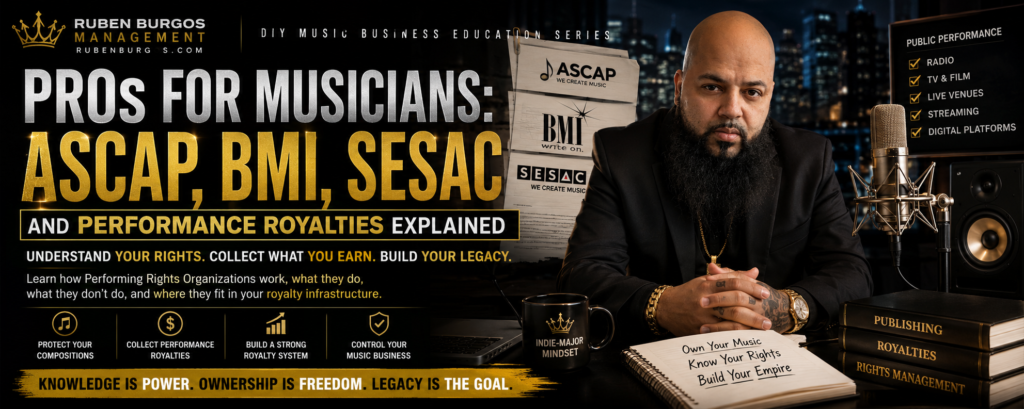
In the United States, organizations such as ASCAP, BMI and SESAC operate within the performance-rights side of the music business. Their fundamental role is connected to licensing public performances of musical compositions and distributing associated performance royalties to songwriters, composers, publishers and other eligible rightsholders.
But joining a PRO does not mean that every possible royalty generated by your music is automatically being collected.
That distinction is where many developing artists get confused.
Understanding your PRO is therefore not simply about joining an organization. It is about understanding where that organization fits inside your overall music royalty infrastructure.
What Is a Performing Rights Organization?
A PRO represents musical compositions for purposes of public-performance licensing.
Think about the underlying song—the melody, lyrics and composition—rather than only the finished master recording.
When compositions are publicly performed in qualifying circumstances, performance royalties may be generated. Public performances can include uses through radio, television, live venues and digital streaming services. PROs license entities responsible for presenting performances, collect applicable fees and distribute royalties according to their systems and policies.
That means a songwriter could potentially be creating value every time a composition receives qualifying public performances.
The important lesson is:
Music isn’t merely something you release. Music contains rights—and different rights can generate different revenue streams.
Understanding those rights is part of becoming a professional.
ASCAP: What Independent Musicians Should Know
ASCAP—the American Society of Composers, Authors and Publishers—is one of the best-known organizations operating in the U.S. performing-rights marketplace.
For the developing artist, the important concept isn’t simply recognizing the ASCAP name. You need to understand why a songwriter or publisher establishes a relationship with a performing-rights organization in the first place.
If you’re writing songs, you should be thinking beyond streams.
You should be asking:
Who wrote this composition?
Who owns what percentage?
Is the composition properly registered?
Who controls the publishing?
Which organization handles applicable performance royalties?
Are the song’s ownership records consistent across the places where they need to appear?
That is business infrastructure.
The independent artist who understands those questions is operating very differently from someone who uploads a song and simply waits for money.
Explore ASCAP’s official website
BMI: Another Major Player in Performance Rights
BMI—Broadcast Music, Inc.—is another major name musicians will encounter when learning about U.S. performance rights.
As with other PRO relationships, artists shouldn’t think of BMI as a replacement for understanding publishing. Your PRO relationship should become one component of a larger rights-management strategy.
Your goal isn’t to collect logos from music organizations.
Your goal is to understand your catalog.
Every serious songwriter should eventually be capable of looking at a song and identifying the writers, ownership percentages, publishing interests, master owner, distributor, relevant identifiers and organizations responsible for different royalty categories.
That knowledge gives an independent artist leverage because knowledge makes it easier to recognize when something is missing.
Explore BMI’s official website
SESAC: An Important Difference
SESAC also operates in the U.S. performing-rights marketplace, but there is an important distinction for artists researching their options.
SESAC states that affiliation is invitation-only and that it does not accept unsolicited submissions. Its guidance suggests having a representative such as a lawyer, manager or agent contact the organization on an artist’s behalf.
That makes researching eligibility and current affiliation requirements important rather than assuming every organization has the same enrollment process.
Explore SESAC’s official website
What Exactly Are Performance Royalties?
Performance royalties relate to the public performance of musical works.
That can become confusing in today’s streaming environment because one stream can implicate multiple rights and royalty categories.
For example, when a song is streamed through an interactive digital service, there can be money associated with the musical composition as well as money associated with the sound recording. On the composition side, performance and mechanical rights are distinct.
This is why saying, “My distributor collects my royalties” may not tell the entire story.
Which royalties?
From which rights?
From which territories?
For which uses?
Those four questions can completely change the conversation.
PROs and The MLC Are Not the Same Thing
One of the most valuable distinctions an independent songwriter can learn is the difference between a PRO and The Mechanical Licensing Collective (The MLC).
The MLC administers a specific category: U.S. digital audio mechanical royalties under the blanket compulsory mechanical license for eligible streaming and download services. It does not collect or distribute public-performance royalties.
PROs and The MLC therefore should not automatically be treated as substitutes for one another.
The MLC itself explains that PROs handle performance royalties while The MLC handles certain digital mechanical royalties. For eligible self-administered songwriters, this can mean that both relationships matter; alternatively, a publisher or publishing administrator may handle certain collections on the songwriter’s behalf.
That is a crucial DIY music-business lesson.
One song can generate multiple royalty streams, and those streams may travel through different organizations.
What PROs Don’t Do
A major mistake musicians make is assuming that registering with a PRO solves their entire royalty situation.
It doesn’t.
A PRO’s role shouldn’t be confused with every other part of music monetization. For example, The MLC specifically handles qualifying U.S. digital mechanical royalties and explicitly says it does not administer public-performance, synchronization or record royalties.
Similarly, your PRO should not simply be assumed to replace your distributor, collect every mechanical royalty, negotiate every synchronization license, manage your master-recording income or perform all the functions of a publisher, administrator, manager or attorney.
Different rights require different infrastructure.
That is why professional artists learn to build a royalty ecosystem rather than relying on one account.
Understanding the Two Copyrights
Another foundational concept is that a commercially released song commonly involves two distinct copyrights:
The musical composition represents the song itself—its music and lyrics.
The sound recording represents the particular recorded performance, commonly called the master.
If you wrote a song and independently financed and own its recording, you might have interests on both sides.
But those sides aren’t interchangeable.
Your composition can generate certain publishing-related royalties, while your sound recording can generate separate master-side income.
Understanding this distinction makes the rest of the music business considerably easier to navigate.
The Independent Artist’s Royalty Infrastructure
Imagine an independent artist named Alex.
Alex writes a song, records it independently, owns the master and releases it through a digital distributor.
The distributor relationship may address income associated with distribution of the recording according to its agreement with Alex.
But Alex is also a songwriter.
Now Alex must think about the composition.
Performance rights matter.
Mechanical rights matter.
Publishing ownership matters.
Accurate registration matters.
Metadata matters.
If Alex assumes the distributor is automatically handling everything associated with the composition, money or data could potentially be overlooked depending on the agreements and services involved.
This is why the modern independent musician has to think like both a creator and rights owner.
Registration and Metadata Matter
Joining an organization isn’t the end of the process.
Your songs also need accurate information.
Song title, songwriter names, ownership percentages, publisher information and other identifying data should be handled carefully. When collaborators write together, ownership discussions should happen early, and split information should be documented.
The digital royalty system depends heavily on matching usage with musical-work information. The MLC, for example, receives usage information from digital services, attempts to match that usage with registered musical works and distributes qualifying mechanical royalties to members when matched.
Bad information creates unnecessary problems.
Treat metadata like money because accurate data helps the industry identify who should be paid.
Don’t Confuse Publishing With Promotion
Independent artists sometimes spend nearly all their energy on visibility:
How many streams?
How many followers?
How many views?
How many playlist placements?
Those things can matter, but generating attention without building the infrastructure behind your catalog can create another problem.
Imagine creating a record that suddenly receives substantial attention while your splits are disputed, publishing information is incomplete and nobody on your team clearly understands who owns what.
Success magnifies whatever infrastructure already exists.
If your business is organized, growth can create opportunity.
If your business is disorganized, growth can magnify confusion.
Which PRO Should You Choose?
There isn’t one universal answer for every songwriter.
Research current membership or affiliation requirements, fees where applicable, payment policies, tools, services, international arrangements, contract terms and how each organization fits your individual situation.
Don’t select a PRO merely because your favorite artist uses it.
Your career is your business.
Read the current terms directly from the organization, ask questions and, when contracts or significant rights are involved, consider getting advice from a qualified music attorney or other appropriate professional.
And remember that SESAC operates differently from open-enrollment models because SESAC describes itself as invitation-only.
Think Independent. Operate Major.
The Indie-Major mindset isn’t about pretending to be a major label.
It means applying professional organization to an independent career.
Major companies understand rights.
They understand metadata.
They understand contracts.
They understand ownership.
They understand catalog management.
They understand that one piece of music can create value through several channels.
Independent artists should educate themselves around those same principles.
Don’t wait until you have a hit record to learn who owns your publishing.
Don’t wait until money appears to ask how royalties work.
Don’t wait until a label meeting to learn the difference between your master and composition.
Build the knowledge before the opportunity arrives.
Final Takeaway: Know Where Your Money Travels
ASCAP, BMI and SESAC are important names for U.S. songwriters to understand because performing-rights organizations occupy an important part of the music royalty ecosystem.
But your PRO is a piece of the infrastructure—not the entire infrastructure.
Performance royalties are different from mechanical royalties. Composition rights are different from master-recording rights. Distribution is different from publishing. Sync licensing creates another set of considerations.
The MLC’s own educational materials emphasize that the digital royalty landscape contains different rights and separate royalty streams, with The MLC, PROs and other organizations serving different functions.
The independent artist who learns those distinctions stops looking at music as simply songs and streams.
You begin looking at your work as a catalog of intellectual property.
And that changes the conversation.
Written by Ruben Burgos Management | RubenBurgos.com
The DIY Music Business Educational Series was created to empower independent and emerging artists with practical knowledge about music publishing, marketing, promotion, branding, syndication, sync licensing, artist development, label preparation, and music-business strategy. Our mission is to help today’s independent artist think bigger, operate smarter, protect their creativity, and develop the infrastructure necessary to take their craft to the next level.
Don’t wait for the music business to teach you the business. Educate yourself. Build your leverage. Own your direction. Think independent. Operate major. Become Indie-Major.
Educational disclaimer: This article provides general music-business education and is not legal, tax, accounting, or financial advice.